
New Haven County Arrest Records and Court Charges
New Haven County arrest records can start with police activity, an arrest report, a recent arrest log, bond information, or custody data. Court charges after arrest begin when the state proceeds in Superior Court. In New Haven, police make arrests and submit reports, but the New Haven Judicial District State's Attorney decides how state criminal charges move forward. The court record then tracks charges, appearances, pleas, motions, dispositions, and sentencing when public.
Connecticut does not have a New Haven County sheriff running a county jail roster. Custody research is split among Connecticut DOC, New Haven Correctional Center, New Haven Police, and court records. The full case file and final outcome belong with New Haven County criminal court records. Booking and custody status may require DOC or police channels rather than a court docket alone.
Find New Haven County Arrest Records
Use the official channel that matches the stage of the event. For recent law-enforcement information, the New Haven Police Police-to-Citizen portal advertises access to law-enforcement information, including inmates/bonds and recent arrest logs. For court charges, use the Judicial Branch criminal and motor vehicle lookup. For custody in a state facility, use Connecticut DOC inmate search or New Haven Correctional Center contact channels.
- Check whether the question is about arrest, custody, pending charges, conviction, or final sentence.
- Use the New Haven Police portal for recent arrest, inmates/bonds, and law-enforcement information when the event is still close to police processing.
- Use the Judicial Branch criminal/motor vehicle pending search for charges filed in court, with New Haven GA 23 as the key local filter.
- Use conviction search only for conviction results, keeping the ten-year display limit and erasure warnings in mind.
- Call the GA 23 clerk, police non-emergency line, or DOC channel when the public web result does not answer the status question.
The manifest image below comes from the official Police-to-Citizen portal. It is useful for the arrest side of New Haven County arrest records, while court charges must still be checked in the Judicial Branch court system.
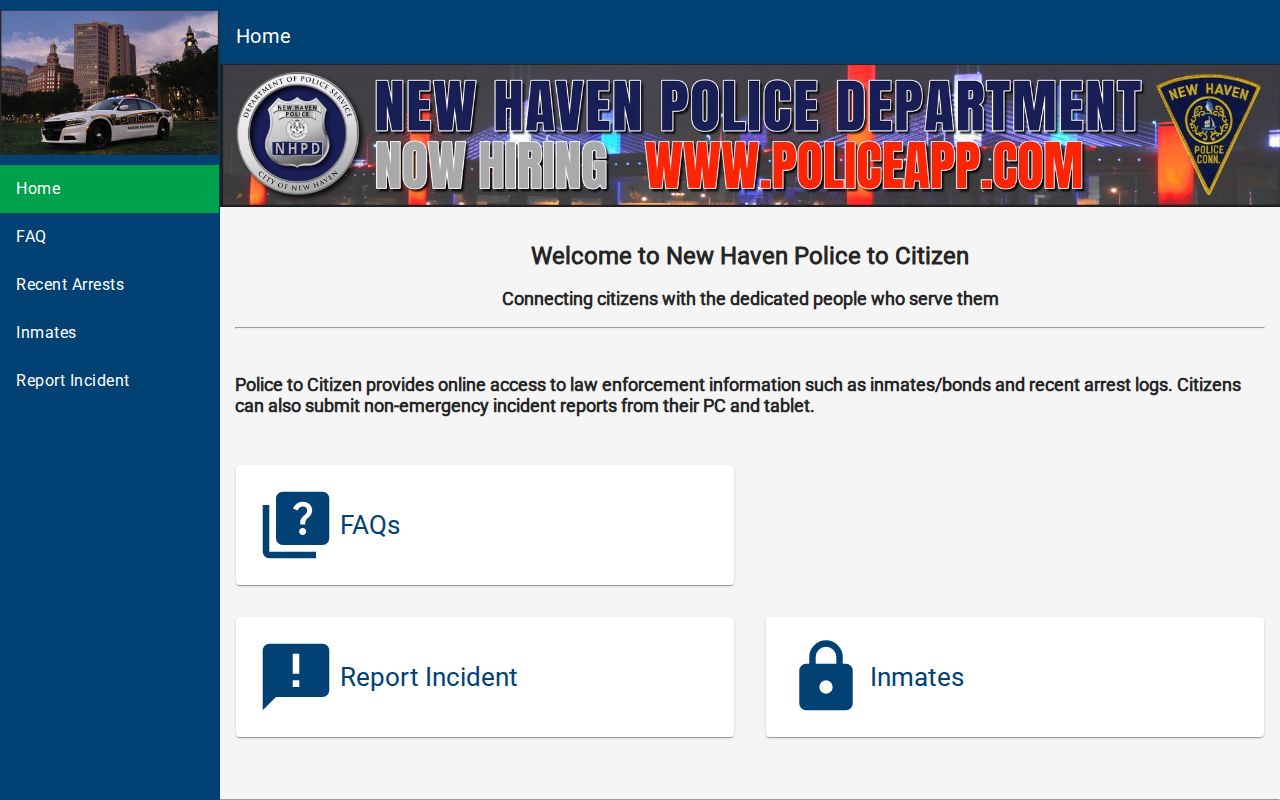
Do not treat a police portal entry as the final court outcome. Charges, pleas, dismissals, nolles, convictions, and sentences are court events.
Charges After Arrest in New Haven
After an arrest, the charging path moves from police action to prosecutor review and court filing. Connecticut research for New Haven identifies the State's Attorney for the Judicial District of New Haven as the state prosecutor and chief law enforcement officer for the judicial district. That office is part of the Connecticut Division of Criminal Justice. The prosecutor's decision is what gives the court charge record its shape.
| Complaint | Information | Indictment | |
|---|---|---|---|
| Filed by | Police or prosecutor path, depending on the matter and court process. | Prosecutor-filed charging document. | Grand-jury route in jurisdictions and cases where that process applies. |
| Role | Starts or supports the charge after arrest. | States formal charges the prosecutor pursues in court. | Accuses a person after grand-jury action. |
| Where it appears | May be reflected in arrest, bond, or early court papers. | Tracked in the criminal court case and docket. | Tracked in the criminal court case if used. |
| Reader caution | Not the same as conviction. | Can be amended, reduced, dismissed, or nolled. | Still must be resolved in court. |
New Haven County Charge Status
Charge status changes as a case moves. A pending charge can be amended if the prosecutor changes the allegation. It can be reduced through plea negotiation or court action. It can be dismissed by the court, or it can be nolled when the prosecutor does not pursue it at that time. A conviction is only one possible result. One arrest can also create more than one charge with different outcomes.
| Status | What It Means |
|---|---|
| Pending | The charge has not reached final disposition in the court record. |
| Amended | The charge text, count, degree, or statute basis has changed during the case. |
| Reduced | The charge is resolved or refiled at a lower level or different offense. |
| Dismissed | The court has terminated that charge or case without conviction on that count. |
| Nolle | The prosecutor has decided not to pursue the charge at that time. |
| Convicted | The charge resulted in a guilty plea, finding, or verdict and may carry sentence terms. |
New Haven Charges vs Convictions
Charges and convictions should never be treated as the same fact. A charge is an accusation. A conviction is a final guilt result after a plea, finding, or verdict. A New Haven County arrest record may show the reason for arrest, and a court charge record may show what prosecutors filed, but neither alone proves the final outcome. The disposition and sentence fields answer the outcome question.
| Charge | Conviction | |
|---|---|---|
| Stage | Filed after arrest or investigation. | Entered after plea, verdict, or finding. |
| Proof value | Accusation only. | Final guilt result unless later changed, erased, or corrected. |
| Can change? | Yes, it can be amended, reduced, dismissed, or nolled. | Yes, through appeal, correction, pardon, erasure, or clean-slate processing when applicable. |
| Where to verify | Pending criminal lookup, docket, GA 23 clerk, or prosecutor/court papers. | Conviction search, disposition, sentence entry, and clerk-certified copy. |
Bond and Bail After Arrest
Bond and bail questions often sit between arrest records and court charges. GA 23 at New Haven lists Bail Services at 203-789-7482 and a bail fax line. The criminal courthouse also has a Chief Clerk's Office at 203-789-7461. If a warrant or arrest has led to custody, the Connecticut DOC search, New Haven Correctional Center, and New Haven Police may be the right access channels depending on where the person is held or processed.
For a missed court date, the warrant portal may show violation of probation, failure to appear, or orders to incarcerate, but it is not a full all-warrants database. For a recent arrest that has not yet appeared in court lookup, the police portal and non-emergency line may be more current than the court case record.
Note: A public arrest or bond entry can update before the matching court charge appears online.
Statewide Charge and History Lookups
The Judicial Branch pending search and conviction search are statewide, but they are not full criminal-history products. Pending search helps locate current New Haven charges and court dates. Conviction search shows public convictions subject to display rules. The lookup page warns that conviction information is generally displayed no more than ten years after sentencing unless Practice Book Section 7-13 provides a shorter period.
New Haven County arrest records may also connect to DOC custody, police records, warrant lookup, and court dockets. The DOC disclaimer states that information is public-safety data, updates daily, may change quickly, and does not include Youthful Offender or ICE-held offenders. That matters when a person was arrested but is not found in DOC search, or when a court charge exists without a current custody record.
Sealed and Erased Charge Records
Connecticut erasure law can affect arrest, police, prosecutor, and court records. Connecticut General Statutes Sections 54-142a and 54-142c cover criminal record erasure and limits on disclosure of erased records. Erasure may follow not guilty findings, dismissals, nolles after the statutory period, pardons, decriminalization, or clean-slate eligible convictions. Once erasure applies, public disclosure is limited.
| Sealed | Erased | |
|---|---|---|
| Public view | Hidden from public access by rule, statute, or court order. | Removed from public disclosure under Connecticut erasure law. |
| Common record types | Juvenile, youthful offender, sensitive family, or court-sealed material. | Eligible criminal records after qualifying outcomes or waiting periods. |
| Effect on charges | May block a charge, document, or full case from public display. | Can prevent public disclosure by court, police, or prosecutor offices. |
| How to confirm | Ask the court of record or counsel about access authority. | Check official erasure, pardon, and Clean Slate guidance, then confirm with the court if needed. |
Restricted New Haven County Charge Records
Restricted charge records include juvenile matters, youthful offender proceedings, erased records, safety-withheld warrants, sealed cases, and some sensitive documents. Juvenile matters are confidential under Connecticut General Statutes Section 46b-124. Youthful offender cases are not shown on the public criminal lookup. The warrant portal also withholds some warrant information when disclosure could endanger safety or when the warrant was issued in a youthful offender proceeding.
For public records that are not court records, use the correct city or agency path. New Haven Police records may require police channels. City administrative records may route through the city's public-records request process. Court-certified charge, disposition, or sentence documents come from the court of record, usually GA 23 for New Haven criminal and motor vehicle matters.