
New Haven County Criminal Court Records
A criminal court record is the court file for a prosecution. In New Haven, it is tied to Connecticut Superior Court, not a county criminal court. The file can show the state against the defendant, docket number, court location, charges as filed, arraignment, bond or release conditions, appearances, pleas, motions, hearings, disposition, sentence, probation, failure to appear events, warrants, and sentence review activity when public.
The main local criminal courthouse is Geographical Area 23 at New Haven, 121 Elm Street. The Chief Clerk's Office there handles criminal and motor vehicle court-record questions for GA 23. Connecticut's unified court system means Superior Court is the trial court, with criminal work assigned by judicial district, geographical area, and case type. The broader civil and family court system is separate from the criminal lookup, although it is still part of the same Judicial Branch.
Search New Haven County Criminal Records
The Criminal / Motor Vehicle Case Look-up page is the starting point for New Haven County criminal court records. It links to pending criminal and motor vehicle cases, daily dockets, criminal convictions, warrants for violation of probation or failure to appear, and sentence review docket information. Pending search and conviction search use similar defendant-name fields, but they answer different questions.
- Open the criminal and motor vehicle lookup page and choose pending search, conviction search, daily docket, or another listed criminal path.
- Enter the defendant's last name prefix. Add a first initial, birth year, or year range if the name is common.
- Use the court location filter for New Haven GA 23, New Haven Judicial District, or another listed New Haven option when appropriate.
- Open the result and review the docket number, category, charge, next event, disposition, or conviction details displayed by the tool.
- Call or visit the court clerk when a certified copy, old paper file, sealed-file question, or document not shown online is needed.
The conviction search page shown below is a successful manifest source. The criminal and motor vehicle convictions search generally displays conviction information for no more than ten years after sentencing unless Connecticut Practice Book Section 7-13 requires a shorter display period.
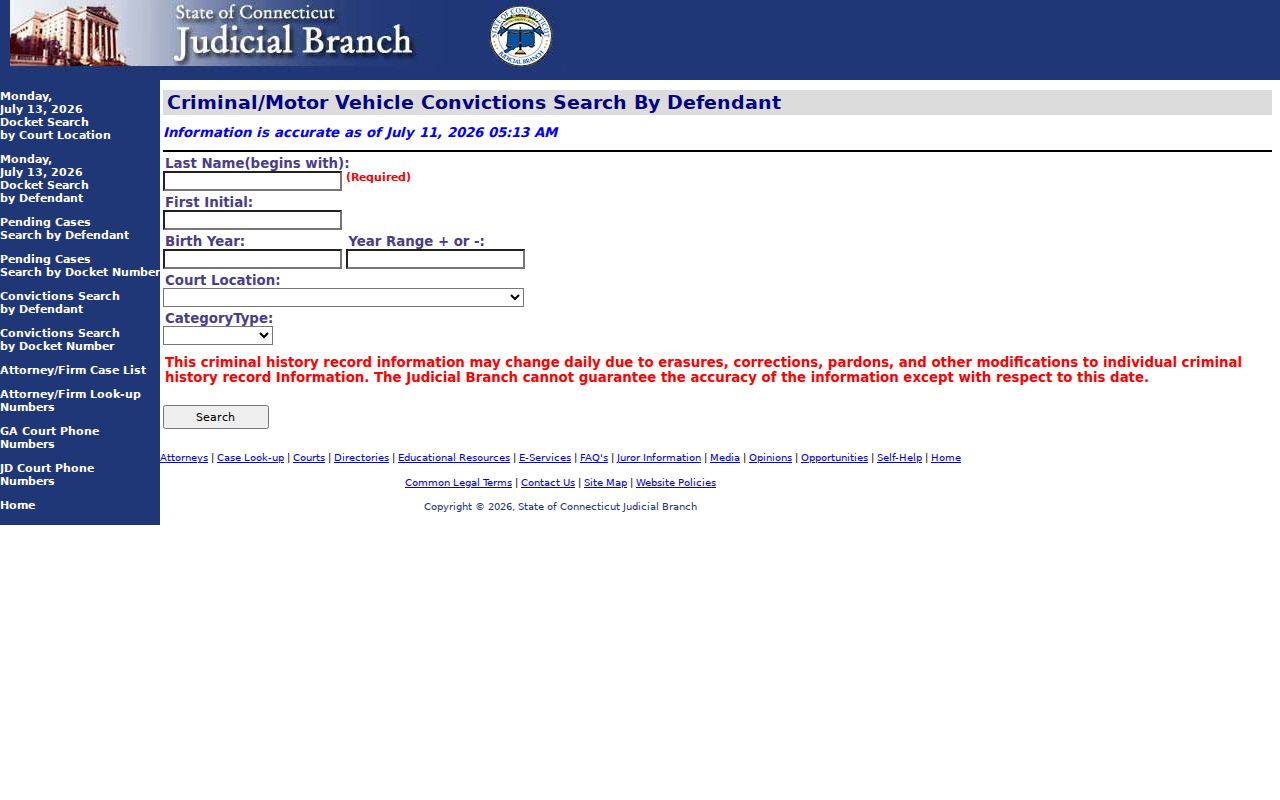
A public conviction result is not a complete criminal-history report, because erasures, corrections, pardons, and display rules can change what appears.
New Haven County Criminal Case Flow
Criminal court records should be read as a sequence. Police may arrest a person and submit reports. The New Haven Judicial District State's Attorney decides how state criminal charges proceed in court. Once charges are filed, the Superior Court case record begins to show court events. The State's Attorney's Office is part of the Connecticut Division of Criminal Justice, while public defense for eligible defendants is handled through the Division of Public Defender Services.
Case flow: Charges Filed › Arraignment › Pretrial / Motions › Plea or Trial › Disposition › Sentencing
| Stage | What Happens |
|---|---|
| Charges filed | The prosecutor files or proceeds on charges after police reports, arrest papers, summons, warrant, or investigation materials. |
| Arraignment | The first court event addresses charges, counsel, release, promise to appear, bond, or custody status. |
| Pretrial / motions | The docket may show continuances, discovery, motions, plea talks, hearings, or rulings. |
| Plea or trial | The record may show a plea, trial result, not guilty finding, conviction, dismissal, nolle, or other outcome. |
| Disposition and sentencing | The court records the final case result, sentence, probation, fines, costs, restitution, or other conditions when public. |
What New Haven County Criminal Records Show
A criminal court record is more than a list of charges. It can identify each public charge, the court location, the docket number, the next court event, appearances, pleas, motions, disposition, sentencing, and probation-related events. It may also show failure to appear, violation of probation, bond, or warrant-related status. For charge-level details without the full case file, use the New Haven County arrest records and court charges page.
| Field | What It Shows |
|---|---|
| Docket number | The criminal or motor vehicle case identifier used by the court and clerk. |
| Defendant | The person charged, with name fields and sometimes birth-year narrowing in search results. |
| Court location | GA 23, New Haven Judicial District, or another court location tied to the case. |
| Charges | Counts or allegations filed in court, which may later be amended, reduced, dismissed, nolled, or resolved. |
| Events | Arraignment, hearing dates, daily docket entries, motions, pleas, trial events, or sentence review entries. |
| Disposition | Conviction, not guilty, dismissal, nolle, plea result, or other final outcome when public. |
| Sentence | Jail, probation, fine, cost, restitution, or other penalty when entered and public. |
New Haven County Charges vs Convictions
A charge is an accusation filed in court. A conviction is an adjudicated result after a guilty plea, finding, or verdict. A New Haven County criminal court record can show charges that never became convictions because they were dismissed, nolled, reduced, amended, or resolved in another way. That distinction is critical when reading criminal records, employment screens, licensing questions, or old docket entries.
| Charge | Conviction | |
|---|---|---|
| Meaning | An allegation filed by the state in court. | A guilty plea, verdict, or court finding resulting in guilt. |
| Timing | Appears early in the case and may change. | Appears only after disposition. |
| Record effect | Can remain on a docket unless dismissed, erased, sealed, or otherwise limited. | May display in conviction search, subject to timing and erasure rules. |
| Reader caution | Do not treat a pending or dismissed charge as proof of guilt. | Still verify sentence, appeal, erasure, pardon, or correction status. |
Read Dispositions and Sentences
Disposition means the way a charge or case is resolved. Common Connecticut criminal record terms include conviction, dismissal, nolle, not guilty, plea, sentence, probation, failure to appear, violation of probation, and capias or order to incarcerate. A nolle is a prosecutor's decision not to pursue a charge at that time. Erasure may later affect what the public can see if the case meets statutory conditions.
Sentencing fields should be matched to the charge and count. One case can have multiple counts with different outcomes. The court record may show a conviction on one charge, a dismissal on another, and a sentence tied only to the count that resulted in conviction. Probation, bond, restitution, fines, fees, and jail terms should be checked against the disposition line and the most recent docket events.
Note: Current incarceration in a DOC search does not always mean conviction because Connecticut also houses pretrial people.
Sealed vs Erased Criminal Records
Connecticut often uses the term erasure rather than expungement. Connecticut General Statutes Chapter 961a, including Sections 54-142a and 54-142c, governs erasure and disclosure of erased criminal records. Erasure can apply after not guilty findings, dismissals, nolles after the statutory time, pardons, decriminalization, and clean-slate eligible convictions. Once erased, court, police, and prosecutor records are generally not disclosed to the public.
| Sealed | Erased | |
|---|---|---|
| Visibility | Not open to the general public by law or court order. | Treated as removed from public disclosure under Connecticut erasure law. |
| Common source | Juvenile, family, sensitive, or court-sealed materials. | Eligible criminal outcomes under Section 54-142a and related clean-slate rules. |
| Access route | Usually requires statutory authorization or court order. | Public disclosure is limited once erasure applies. |
| Online effect | May suppress documents or entire case information. | Can remove or change what criminal lookup and police records disclose. |
Public Criminal Court Access
New Haven County criminal court records are public only within Connecticut's display rules and confidentiality laws. The criminal lookup page warns that youthful offender cases, juvenile cases, and infractions or violation convictions are not displayed. It also warns that criminal history information may change daily because of erasures, corrections, pardons, and other modifications. Those warnings matter as much as the result itself.
Connecticut FOIA provisions support public agency record access unless an exemption, statute, or court rule applies. Juvenile matters are confidential under Section 46b-124. Criminal erasure and disclosure limits are handled by Chapter 961a. For official copies, use the GA 23 clerk or the court of record rather than a third-party criminal search site.
The image below comes from the manifest source for Connecticut criminal-record erasure statutes. These statutes affect what New Haven County criminal court records remain publicly visible.
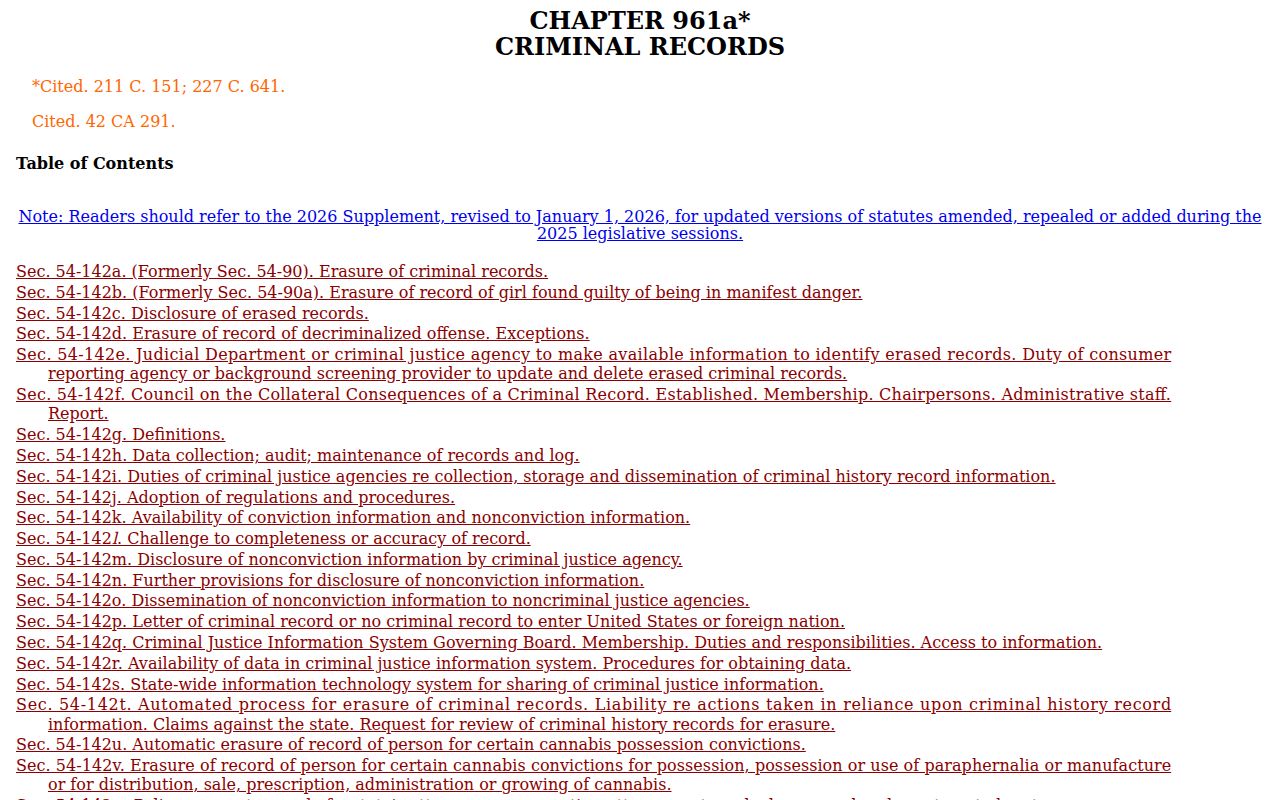
When a case result seems to have disappeared or changed, erasure, correction, pardon, or clean-slate processing may be the reason.
Restricted New Haven County Criminal Records
Restricted criminal records include juvenile matters, youthful offender proceedings, erased cases, sealed files, certain safety-sensitive warrant information, and documents withheld by court rule or order. The warrant portal also states that outstanding warrant information will not appear if posting could endanger safety or if the warrant was issued in a youthful offender proceeding. A missing public result is not proof that no case, warrant, or custody event exists.
For unresolved charges, missed court dates, or bond questions, use the official criminal lookup, daily docket, GA 23 clerk, and counsel. For custody status after a criminal arrest, the DOC and police channels may be more useful than the court record alone. For active warrant research, use the official warrant page rather than assuming all warrant information appears in the criminal case docket.