
New Haven County Superior Court
The State Court Structure Map identifies the primary trial court as the Superior Court. Connecticut's Judicial Branch history explains why: the Superior Court became the sole trial court of general jurisdiction in 1978, after earlier mergers replaced the county court, municipal court, Circuit Court, Court of Common Pleas, and Juvenile Court model. Connecticut abolished county government in 1960, so "New Haven County Court" is not the current trial court name even though New Haven remains a major court location.
For New Haven, Superior Court work is split by function and building. The New Haven Judicial District courthouse at 235 Church Street handles civil, family, judicial district work, court service center access, law library access, and adult probation. Geographical Area 23 at 121 Elm Street handles criminal arraignments, misdemeanor and felony preliminary proceedings, motor vehicle matters requiring court appearance, and bail services. Housing and small claims are Superior Court sessions searched through state lookup paths.
The U.S. District Court case information page is not the state Superior Court, but it is useful because New Haven also has a federal courthouse and separate federal case access.
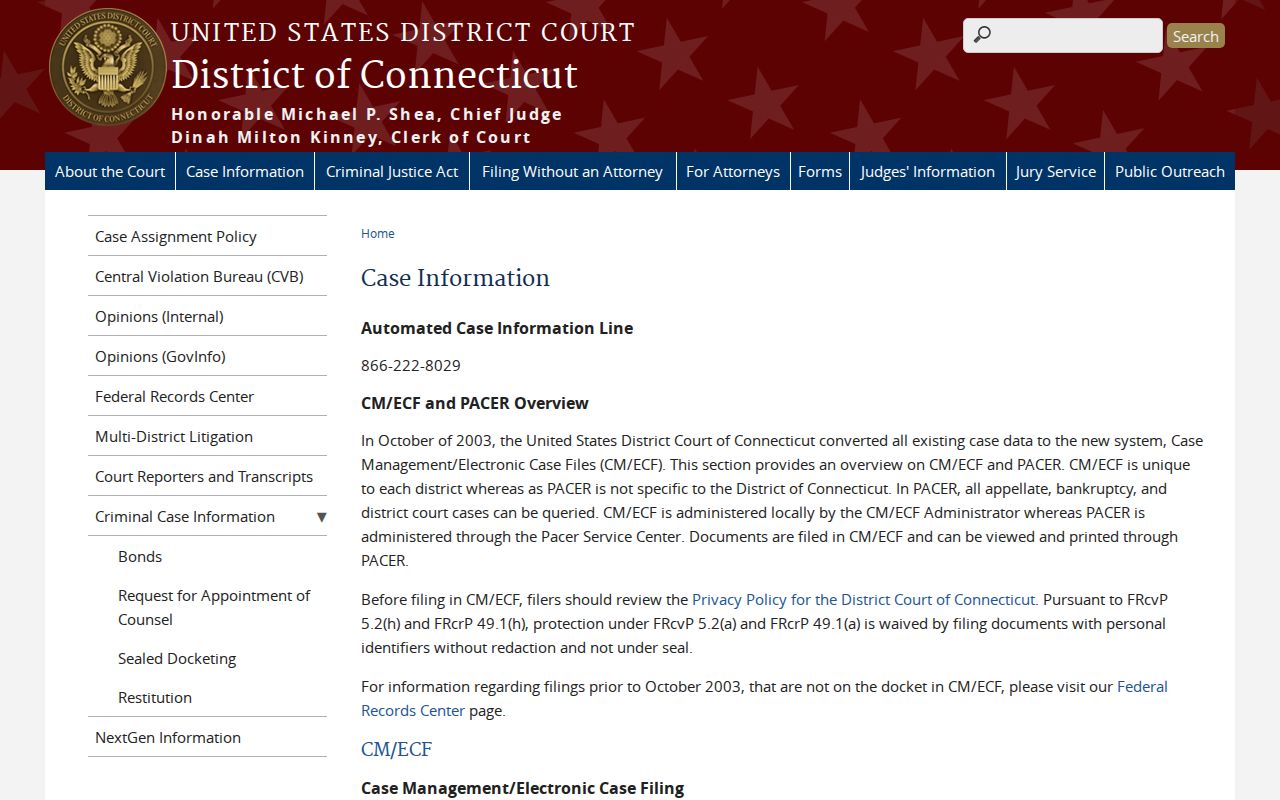
That distinction matters when a searcher has a federal docket, because Connecticut Judicial Branch portals will not show U.S. District Court cases.
New Haven County Superior Court Locations
The phase instructions call for a full table of every numbered court. Connecticut does not use numbered district courts for New Haven County. The equivalent local table is the Superior Court hierarchy and court offices identified in the research, including the Judicial District, GA 23, Housing Session, Small Claims, Centralized Infractions Bureau, Probate Court, and the regional children's probate court.
| Court or office | Type | Address | Phone |
|---|---|---|---|
| New Haven Judicial District Superior Court | Civil, family, judicial district | 235 Church Street, New Haven, CT 06510 | 203-503-6800 |
| Geographical Area 23 at New Haven | Criminal, motor vehicle, arraignment, bail services | 121 Elm Street, New Haven, CT 06510 | 203-789-7461 |
| New Haven Housing Session | Housing summary process and landlord-tenant matters | Use NHH in statewide lookup; verify courthouse details through Judicial Branch directory | See Judicial Branch directory |
| Small Claims Session | Money-damages small claims | Statewide Superior Court Small Claims or Centralized Small Claims lookup | See Judicial Branch small claims page |
| Centralized Infractions Bureau | Traffic infractions and online ticket pleas or payments | Statewide Judicial Branch infraction system | traffictickets@jud.ct.gov |
| New Haven Probate Court PD-38 | Probate Court | 200 Orange Street, 1st Floor, New Haven, CT 06504-0905 | 203-946-4880 |
| New Haven Regional Children's Probate Court PD-55 | Children's probate matters | 873 State Street, New Haven, CT 06511-3923 | 203-773-9556 |
New Haven County Superior Court Hierarchy
Connecticut's hierarchy is statewide: Connecticut Supreme Court, Connecticut Appellate Court, Connecticut Superior Court, Connecticut Probate Courts, and specialized Superior Court sessions such as judicial district, geographical area, housing, family, juvenile, small claims, and centralized infractions. Appeals from Superior Court final judgments generally go to the Connecticut Appellate Court, with the Connecticut Supreme Court as the highest state court. Probate Court decisions may be appealed to the Superior Court when statute allows.
| Level or session | New Haven role | Record access path |
|---|---|---|
| Connecticut Supreme Court | Highest state court | State appellate lookup from the Judicial Branch |
| Connecticut Appellate Court | Intermediate appeals from Superior Court final judgments | State appellate lookup from the Judicial Branch |
| Connecticut Superior Court | Main trial court for New Haven civil, family, criminal, motor vehicle, housing, and small claims work | Judicial Branch civil/family and criminal/motor vehicle portals |
| Connecticut Probate Courts | Separate probate districts including New Haven PD-38 | Probate case lookup and local Probate Court contact |
| Federal courts | Separate U.S. District Court matters in New Haven | CM/ECF and PACER, not state Judicial Branch lookup |
The Connecticut Judicial Branch history page explains the unified trial-court development that makes Superior Court the key trial court for New Haven County case records.
Superior Court vs Probate Court
The template asks for a trial court comparison block. For Connecticut, the meaningful comparison is not Superior Court versus county court versus justice court, because current county courts and justice courts are not part of the New Haven structure. The correct comparison is Superior Court, Probate Court, and the lower or specialized paths listed in the State Court Structure Map.
| Question | Superior Court | Probate Court | Specialized lower path |
|---|---|---|---|
| Main case types | Civil, family, criminal, motor vehicle, housing, small claims, juvenile sessions | Estates, trusts, conservatorships, guardianships, mental-health commitments, name changes, children's matters | Centralized Infractions Bureau for many traffic infractions; Housing and Small Claims sessions for focused civil matters |
| New Haven office | 235 Church Street for Judicial District; 121 Elm Street for GA 23 | 200 Orange Street, 1st Floor, PD-38 | Statewide portals and session-specific lookup paths |
| Public lookup | Civil/family/housing/small claims portal and criminal/motor vehicle portal | Probate Case Lookup for estates and trusts | CIBEpay for infractions, Small Claims lookup, Housing Session filters |
| Certified copies | Chief Clerk's Office for the court of record | New Haven Probate Court for probate filings and decrees | Depends on the session or bureau holding the record |
New Haven County Case Flow
Civil and family Superior Court cases usually begin with filing in the Judicial District, service, appearances, pleadings or motions, scheduled events, possible short calendar activity, judgment, and appeal if allowed. Criminal and motor vehicle cases can start with arrest, summons, or ticket-related events, then proceed through arraignment or first appearance at GA 23, pretrial hearings, plea or trial, disposition, sentence, and appeal. Housing and small claims use narrower session rules but still sit within the Superior Court framework.
Civil and family flow: Filing › Service or notice › Appearance › Motions or pleadings › Scheduled events › Judgment or disposition › Appeal.
Criminal and motor vehicle flow: Arrest or summons › Arraignment or first appearance › Pretrial › Plea or trial › Disposition › Sentencing › Appeal.
For certified copies after the case moves through these steps, the Clerk of the Superior Court / Chief Clerk's Office is the route for court-held New Haven County Superior Court records.
New Haven County Superior Court Divisions
Civil records include complaints, appearances, motions, objections, orders, judgments, foreclosures, contract disputes, collections, torts, administrative appeals, and civil protection order records. Family records include dissolution of marriage, nonadversarial divorce, legal separation, annulment, custody, visitation, support, parentage, foreign matrimonial judgments, family support magistrate matters, and relief from physical abuse. Housing records include summary process, rent and damages, return of security deposit, housing code enforcement, entry and detainer, injunctions, and housing administrative appeals.
Criminal court records include pending criminal cases, daily criminal dockets, convictions, charges, appearances, pleas, dispositions, sentencing, warrants, bond information, probation events, and sentence review docket entries. Motor vehicle records appear in both criminal/motor vehicle lookup and the Centralized Infractions Bureau ticket portal, depending on whether the matter is an infraction, a payable ticket, or a case requiring court appearance. More serious motor vehicle charges such as DUI/OUI, driving under suspension, evading responsibility, and reckless driving can route through criminal/motor vehicle court.
Federal Court in New Haven
Federal court is separate from New Haven County Superior Court. New Haven is in the U.S. District Court for the District of Connecticut, and the Richard C. Lee United States Courthouse is at 141 Church Street, New Haven, CT 06510. The public hours listed in the research are Monday through Friday, 9:00 a.m. to 4:00 p.m., closed 12:30 p.m. to 1:00 p.m. The phone is 203-773-2140, and the federal Clerk's Office number is 203-773-2334.
The image assigned from the Richard C. Lee United States Courthouse page shows the federal New Haven courthouse source, which should not be confused with Superior Court records.
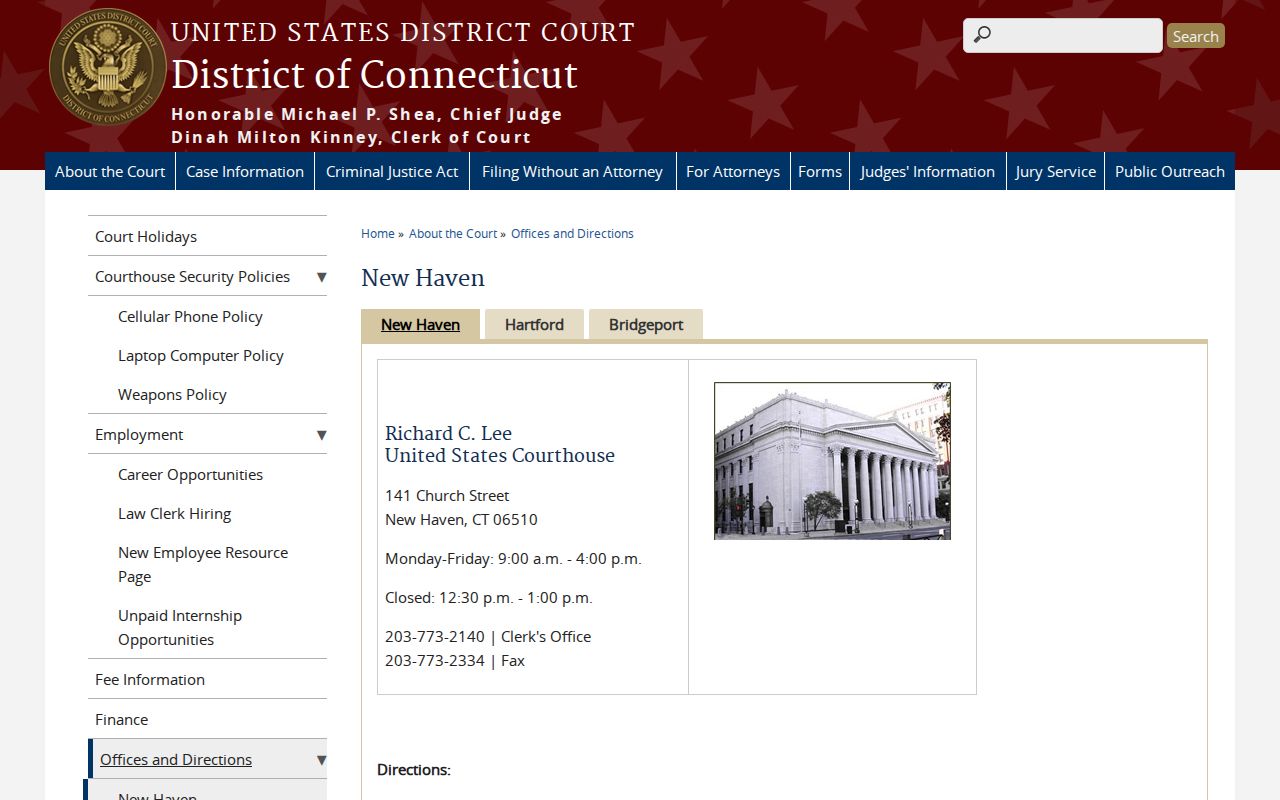
Federal docket access generally uses CM/ECF and PACER, while state Superior Court records use Connecticut Judicial Branch portals and courthouse clerks.
Search New Haven County Superior Court
The statewide Judicial Branch case lookup page is the main entry point for New Haven County Superior Court records. Civil, family, housing, and small claims searches route to the civil inquiry portal. Criminal and motor vehicle searches route to the criminal/motor vehicle lookup pages. Searchers should choose New Haven location filters such as NNH for New Haven Judicial District, NHH for New Haven Housing Session, and New Haven Geographical Area 23 for criminal and motor vehicle court matters.
Use docket number when available because it avoids name variations. The research also notes that scheduled events update nightly and that short calendars are generally available Thursday afternoon. Youthful offender and juvenile cases are not shown in public criminal lookup, and conviction information is generally displayed no more than ten years after sentencing unless Connecticut Practice Book Section 7-13 provides a shorter period. Erased, sealed, juvenile, and sensitive family records may be restricted even when a related public docket exists.